A life between music, spirituality, and Jewish teaching
Introduction
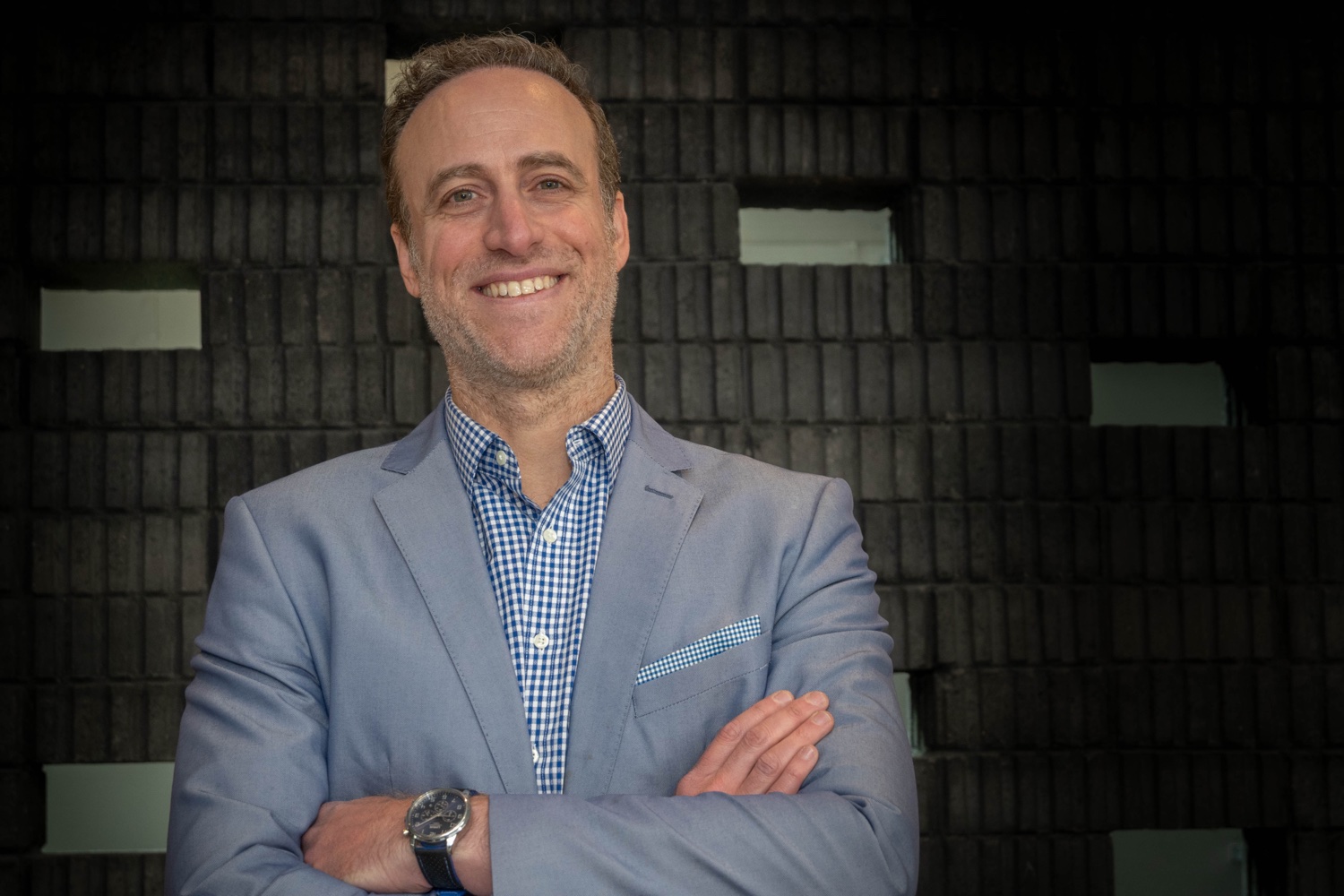
Diego Edelberg is a Conservative Masorti Rabbi, educator, musician, and communicator. Born in Buenos Aires in 1981 into a Jewish family whose grandparents emigrated to Argentina before World War I, he has served as a spiritual and educational leader in Jewish communities across Brazil, Argentina, Hong Kong, Chile, and Mexico for more than two decades. He currently serves on the rabbinical team of Comunidad Bet El de México, where he leads the educational development of the Beit Midrash alongside Rabbi Leonel Levy and Hazzan Ari Litvak.
His vocation weaves together academic rigor, artistic sensibility, and a deep spiritual life. Diego believes that the ancestral wisdom of the Jewish people, integrated with modern tools from neuroscience, mindfulness, psychology, and coaching, can help people live fuller, freer, and more meaningful lives. His greatest passion is transforming lives through great spiritual ideas.
A personal search for meaning
From a very young age, Diego searched everywhere for answers to the meaning of life — looking for a truth that could reach both his heart and his mind. Along the way he got lost many times and found himself in others, traveling from physics to metaphysics, and from organized religion toward an individual spirituality.
Diego often says that many people believe he lives the life he wants, but in reality, each day he realizes that he wants the life he lives. It is not just wordplay: it is the insight that allows him to accept both the good and the bad as an indivisible whole. He never imagined being a Hazzan, nor living in Hong Kong, nor writing a blog about Judaism, nor pursuing a Master’s in Boston, nor serving as a Rabbi in Chile and Mexico. It simply happened. And from that open and grateful attitude toward what life proposes flows much of his public voice.
Childhood and youth in Buenos Aires
Diego grew up in Buenos Aires between two passions that would shape his life: music and sports. During his formative years he stood out as a basketball player at Club Náutico Hacoaj, where he made the Capital Federal preselection and represented Argentina at the 1997 Maccabiah Games in Israel. Although sports played a central role in his adolescence, it was music that ultimately won his heart.
He completed his technical training at Escuela Técnica ORT, where he graduated as a Music Production Technician between 1994 and 2000, while simultaneously beginning private studies in voice, piano, harmony, counterpoint, and chamber music with first-rate teachers: Juan Rodó, Ida Terkiel, and Eduardo Cogorno in voice; Beatriz Tabárez in piano and music theory; Guillermo Pozzatti in harmony, counterpoint, and musical morphology; and Guillermo Ángel Opitz in chamber music.
Musical formation: piano and voice
Between 2001 and 2008 he pursued a Bachelor’s degree in Musical Arts, specializing in piano, at the National Conservatory of Music of Buenos Aires (IUNA). There he also deepened his work in chamber music and opera, training as a tenor. His graduation thesis, inspired by the concept of interpretation, articulated an idea that would accompany him throughout his life: to be human is to be an interpreter. Everything, absolutely everything, depends on who stands as the intermediary between what a text says and the reader, with their own biases and expectations. The idea of the interpreter, of interpretation, and of reinterpreting any human tradition — from the existential Jewish to the artistic musical — is a concept that fascinates him to this day and runs through all his work.
Piano remains a daily companion. At night, as a personal hobby and refuge, Diego studies works by Chopin, Bach, Debussy, Rachmaninoff, Beethoven, and other great composers of the classical and romantic repertoire. That nightly practice is his private way of continuing to converse with the beauty, discipline, and mystery of music.
First steps as a Hazzan
At 18, Diego officiated for the first time as Hazzan in Brazil, at the Grande Templo Israelita do Rio de Janeiro during the Yamim Noraim of 2001. That experience awakened in him a deep calling for liturgy and spiritual leadership. Upon returning to Buenos Aires, he joined the team of officiants at the Templo de la Calle Libertad, in the Congregación Israelita de la República Argentina, then led by Rabbi Sergio Bergman.
For ten years, between 2002 and 2010, he served this historic community in multiple roles: liturgical officiant, ba’al tefillah, ba’al kore, educator, and community reference. In parallel he attended the Shlijei Tzibur Higher Education Institute from 2000 to 2005, a specific training program for shlichei tzibbur created under the direction of Rabbi Sergio Bergman.
Hong Kong: five years in Asia
In 2010 a unique opportunity arose to serve as Hazzan of the United Jewish Congregation of Hong Kong, where Diego worked until 2015. At UJC he covered four main areas: conducting weekly and festival religious services, the community’s educational and musical programming, formal and informal education of children and youth toward Bar and Bat Mitzvah, and community representation in regional Jewish organizations.
Among the milestones of this stage, he led the first non-Orthodox Pesach Seder in Shanghai and participated in community events together with the Jewish Women’s Association, the Holocaust and Tolerance Centre, and the Jewish Community Centre of Hong Kong. This Asian chapter also meant a major expansion of intellectual and spiritual horizons that would transform his vision of Judaism and Jewish education.
Hebrew College and the birth of the blog
During his time in Hong Kong, Diego began two projects that would profoundly shape his trajectory. The first was his Master’s in Jewish Education at Hebrew College in Boston, in a hybrid in-person and virtual format, which he later completed Summa Cum Laude with a thesis on Synagogue Engagement — dedicated to exploring how to strengthen the bond between people and their synagogue communities in the 21st century.
The second project was judiosyjudaismo.com, the blog he launched in March 2011, which would become one of the most relevant spaces for Jewish thought in Spanish. The site addresses Jewish history, theology, philosophy, Halakhah, Jewish modernity, and contemporary topics with academic rigor and a distinctive voice. At its peak around 2016, the blog surpassed 400,000 annual visitors and brought together more than 10,000 email subscribers from around the world. From its pages Diego published three free ebooks: an introduction to Jewish history, one to Jewish theology, and The 22 Essential Words of Judaism, which together have exceeded 100,000 downloads.
The spirit of the blog reflects the spirit of its author: an intellectually honest and emotionally challenging approach to Judaism that considers both ancient and modern interpretations of the rabbinic tradition alongside contemporary academic scholarship. It does not seek to offer final, irrefutable, or absolute answers; on the contrary, it invites us to embrace contradictions, tension, what remains unresolved, the paradoxical, the ironic, and the absurd. For Diego, living in peace is not about making everything fit together, but about developing the capacity to inhabit uncertainty with faith and meaning.
In 2006 he also recorded the album Tu canción es mi canción (Your Song is My Song), featuring his own musical compositions for the Kabbalat Shabbat service.
Costa Rica 2017: the turn toward Musar and Soul-Education
In 2017 Diego traveled to Costa Rica for ten days to attend a Jewish retreat led by Rabbi Marcelo Bronstein. That experience moved him as few others had: he spent those ten days without internet, meditating and working deeply on his inner life, in an immersive format that combined study, silence, nature, contemplative practices, and community connection. For Diego it was a personal and rabbinical turning point: the confirmation that the Judaism he wanted to teach and live could not be limited to intellectual transmission but needed to touch the most intimate layers of the person.
That trip awakened in him a deep interest in Musar, the ancient Jewish discipline of working on the midot, the traits of character. Soon after, Rabbi Aryeh Ben David came into his life, from whom he learned the model of Soul-Education, a Jewish pedagogy aimed at uniting mind with heart, emotion, and soul. Diego began implementing these ideas both in Chile and in Mexico, giving new depth to his educational and spiritual work: classes that not only inform but transform; encounters where the text becomes a mirror, and study becomes a path of inner growth.
Teachers and inspirations
Diego recognizes that he has been deeply shaped by his teachers. For him, a Jew is first a Jew, and only afterward Orthodox, Reform, Conservative, or anything else. That same openness applies to the scholars he reads: many are not Jewish and yet they illuminate the tradition in invaluable ways. In his view, an honest seeker should not filter what to read and what not to, since doing so would mean returning to the past and repeating orders like a robot, instead of challenging oneself with new arguments.
Among his Jewish teachers he counts Rabbis Mario Rojzman, Sergio Bergman, and Rabbi Dr. Fernando Szlajen, who helped him sharpen the central idea of his Conservatory thesis on interpretation. He had the privilege of studying personally with Daniel Matt, who introduced him to the world of Kabbalah and taught him how to live in peace with uncertainty, applying that teaching of Isaac of Akko: strive to see, but do not drown. He also studied personally with Art Green, one of the deepest and most living voices of contemporary Jewish spirituality, and with Rabbi Burton Visotzky, who opened Midrash for him in a novel way. In the realm of Halakhah, a fundamental teacher was Rabbi David Golinkin, with whom he studied for a full year in Israel and from whose work he draws extensively in his presentations on Masorti Halakhah in modern life.
Other foundational voices from the rabbinic and academic worlds that have shaped his thinking include David Wolpe, Ethan Tucker, and YY Jacobson, alongside authors such as Rav Shlomo Wolbe Z»L, Rabbi Simon Jacobson, Adin Steinsaltz, David Hartman, Akiva Tatz, Rabbi Jonathan Rietti, and Rabbi Lawrence Keleman. In theology, Neil Gillman has been one of the most important figures in his life, to the point of saving him many times from meaninglessness. Rabbi Jonathan Sacks is a continuous source of inspiration for his interpretation of otherness, and Nehama Leibowitz accompanies him as a study companion through her work.
Two authors transformed his approach to Judaism in a definitive way. Lawrence Hoffman, through his monumental work on Jewish liturgy and prayer, particularly his My People’s Prayer Book collection. And David Ruderman, his most significant mentor, who showed him that the union between academic scholarship and rabbinic studies is no longer optional but obligatory for living the Judaism of our time. The blog’s series on Modern Judaism and Medieval Judaism are directly inspired by Professor Ruderman’s courses for The Teaching Company.
Beyond the specifically Jewish world, his thinking is in dialogue with contemporary voices in psychology, neuroscience, leadership, and creativity: Sam Harris, Marie Forleo, Tim Ferriss, Adam Grant, Andrew Huberman, Elizabeth Gilbert, Martha Beck, Mel Robbins, Simon Sinek, among many others. This cross-conversation between tradition and contemporaneity, between Beit Midrash and the secular world, is one of the most distinctive features of his voice.
Chile: spiritual leadership and rabbinic formation
In 2015, Diego and Laila decided to return to South America. A Chilean community, Ruaj Ami, welcomed him as its spiritual leader, beginning a period of intense personal and professional growth. At the same time, he began his rabbinic studies at the Seminario Rabínico Latinoamericano «Marshall T. Meyer», combining in-person and virtual learning.
During those years he completed his Master’s at Hebrew College with honors and, near the end of his rabbinic studies in the region, traveled to Israel to complete his training with the support of the Círculo Israelita de Santiago, a community where he also served as rabbi before being called to Mexico.
Mexico: the current chapter at Bet El
On August 1, 2020, Diego joined the rabbinical team of Comunidad Bet El de México, one of the most important Conservative-Masorti communities in Latin America. There he works alongside Rabbi Leonel Levy and Hazzan Ari Litvak, with a particular focus on the in-person and virtual educational development of the Beit Midrash.
Today Diego is considering a new professional chapter focused entirely on the Beit Midrash area at Bet El, delegating operational tasks to concentrate on content, teaching, and creativity. The Beit Midrash Bet El / Beit Midrash 360 project is a comprehensive community transformation initiative that seeks to integrate classes, retreats, art, music, experiential spirituality, Musar, coaching, and digital content. Partially inspired by the Hadar model but with its own imprint, this project represents the synthesis of all his learnings and passions.
Creative projects and intellectual production
Pasión y Gratitud
The YouTube channel Pasión y Gratitud brings together multiple verticals of content. The two productions Diego personally hosts are Judaísmo Picante and Conquista y Ríndete. Judaísmo Picante offers rigorous analysis of polemic or contemporary topics from a Jewish perspective, addressing issues like fake news, kol isha, musical instruments on Shabbat, minyan, electricity and Halakhah, pathological narcissism, and current halakhic debates — always with original sources in Hebrew and Spanish. Conquista y Ríndete, by contrast, offers narrative-reflective episodes on emunah, yirah, and personal transformation. A new production with guests, called Vivir a Propósito, is in the launch process.
Programs and series
Diego develops multiple long-form educational programs. Shlemut integrates Tony Robbins’s teachings with Jewish sources to work on identity, ratzon, and personal transformation. His spiritual retreat based on Changing the World from the Inside Out by Rabbi David Jaffe combines Musar, coaching, journaling, teshuvah, and the work of midot. The Ajat Shaalti series for Elul offers thirty daily texts with a fixed structure of preparation for the High Holidays. His complete course on Hilchot Teshuvah is grounded in Maimonides’s thought.
His Integrative Spiritual Program is also active, combining coaching, Musar, Hasidut, Aryeh Ben David’s Soul-Education model, Tony Robbins’s teachings, and body-mind-soul practices. His podcasts on Apple Podcasts and Spotify bring together sermons, classes, and reflections, reaching hundreds of episodes.
Coaching, inner life, and daily discipline
In recent years Diego has deepened his coaching training under the approach of his teacher and friend Fred Kofman and the CBC+ (Conscious Business Coaching) methodology, seeking to integrate the coach’s role with his rabbinic and educational work.
His personal routine speaks to the depth with which he takes on his vocation. Each morning he wakes at five for an integrative practice of conscious breathing, visualizations, physical exercise with an emphasis on kettlebell strength training, guided meditations through Sam Harris’s Waking Up app and other teachers, recitation of neuroscience-grounded phrases, and a cold shower. This daily discipline sustains his creative, intellectual, and spiritual work throughout the day.
Diego defines himself as a conservative thinker who seeks balance and the middle path, avoiding extremes and fundamentalisms of any kind. He actively works on self-esteem, assertiveness, and boundaries as essential dimensions of his personal growth. He is passionate about academic learning, especially courses from The Teaching Company, music, the arts, fitness, and science.
Family: the center of it all
Diego is married to Laila Lask, his life partner and collaborator in every important decision. They are the parents of four children. For Diego, family is not only the emotional center of his life but also the most everyday source of his vocation: to teach, to transform, to transmit tradition.
Vision and mission
His greatest passion is helping people live fuller lives through the ancestral wisdom of the Jewish people. His work fuses academic scholarship, mysticism, Musar, and spirituality, while also integrating modern tools from neuroscience, mindfulness, and coaching in a continuous search for a more meaningful, balanced, and free life.
One of his favorite definitions of Jewish tradition is «the constant rethinking of the text in context». That is: reading the text of the past, or what those who reflected on their own tradition in their own time wrote, confronting it with a new context, a new world, a new social reality, a new cultural challenge — and facing that challenge without fear, reformulating tradition within it. For Diego, what is essentially Jewish is precisely that notion of rethinking, reinterpreting, and reformulating Judaism, just as with any other great religious tradition.
His central vocation is to transform lives through great spiritual ideas, integrating intellectuality, scholarship, spirituality, and human closeness. He believes deeply in a progressive and egalitarian Jewish life, where education, religious services, and the celebration of the life cycle help foster and perpetuate a positive, passionate, and world-open Jewish identity and belonging. The goal of the Jew, he says, is always to read within tradition his or her own voice, participating in a conversation with the tradition and the Jews who came before — without ignoring that past, but daring to rethink and reformulate it so that it becomes relevant and meaningful today.
Academic background
- Rabbinical Ordination. Seminario Rabínico Latinoamericano «Marshall T. Meyer», Buenos Aires, with complementary training in Israel.
- Master’s in Jewish Education. Hebrew College, Boston, Summa Cum Laude. Thesis on Synagogue Engagement.
- Bachelor of Musical Arts, Piano specialization. National Conservatory of Music of Buenos Aires (IUNA / Universidad Nacional de las Artes).
- Shaliach Tzibbur Training. Shlijei Tzibur Higher Education Institute, directed by Rabbi Sergio Bergman.
- Music Production Technician. Escuela Técnica ORT, Buenos Aires.
Today
Today, from Mexico City, Diego continues to expand his vision: a deep, rigorous, and living Judaism, capable of dialoguing with the challenges of the 21st century without losing its millennial root. A Judaism that teaches, that cares, that transforms. A Judaism of the open Beit Midrash, where study becomes a path, and the path becomes life.